
Bhawana Datta
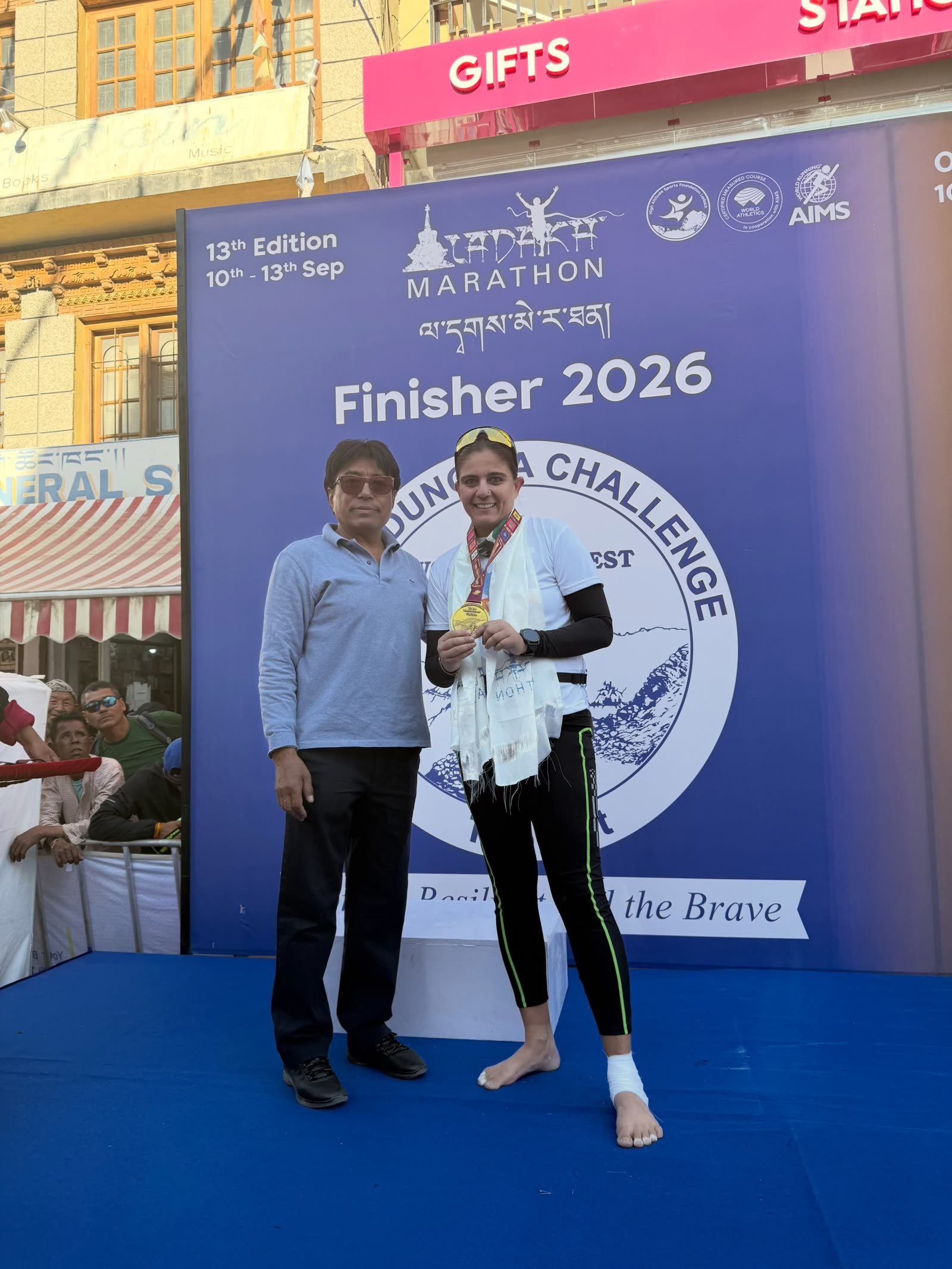
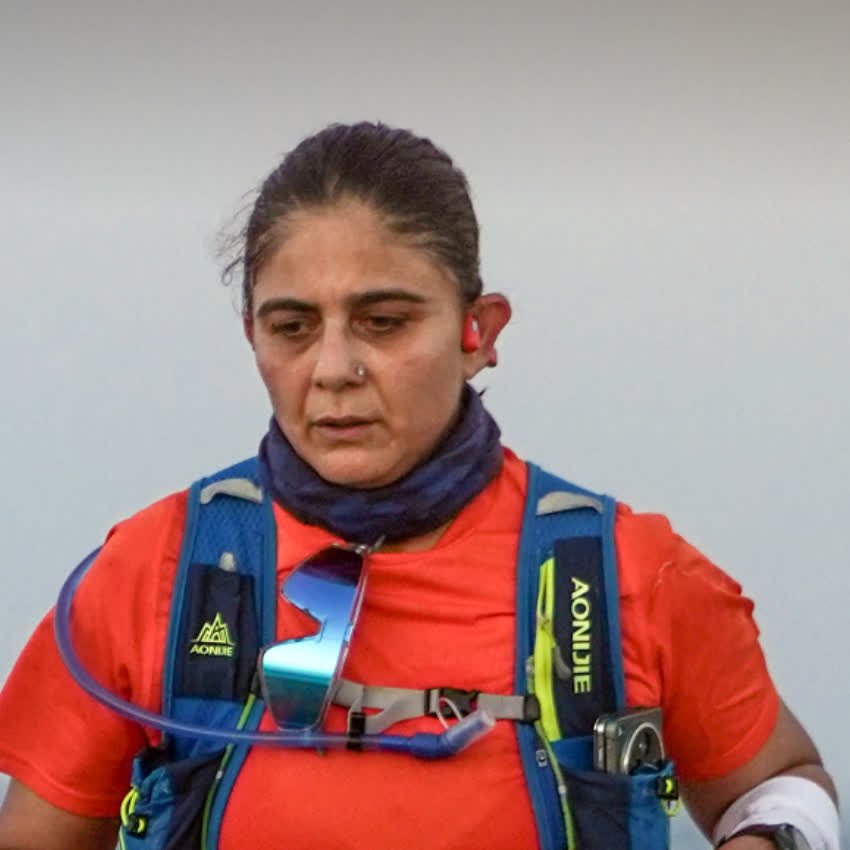
On 11 September, Bhawana Datta finished the 2026 Khardung La Challenge in 12 hours 55 minutes 26 seconds, her third finish at the race and her fastest. She ran the last 40 kilometres of it with almost no sight in her left eye. She didn't stop, and she didn't tell race officials until she had crossed the line.
It's 72 kilometres. The race starts at 3 AM in Khardung village, at about 3,970 metres, climbs for 32 kilometres to the Khardung La pass at 5,355 metres, then drops nearly 1,900 metres down into Leh. This year 300 runners started and 291 finished. Bhawana's start-line number was 7291. Her own record at the race, as she gave it to us: 13:45 in 2023, 13:05 in 2024. Ladakh Marathon's website lists only the top finishers in each category, so those two times are hers, not an official record we could check. The 2026 time is the official one.
To understand why this one mattered to her, it helps to know who's running. Bhawana has been running since 2017, and running is only one part of her life. She describes herself first as a healer: a clinical hypnotherapist, theta healer, Access Bars practitioner, shamanic healer and energy reader. She founded the clothing brand Indra n Ivy. She has trekked Pin Bhaba Pass, the Chadar trek, Mangankot, and both the Annapurna and Everest base camps, ridden two century rides and one 200 km ride, and calls herself a biker at heart and a Kathak dancer. On the road she has podiums at the Amritsar and Gurugram half marathons and Aravali Trails. In ultras she has two White Sand Ultra podiums (2nd and 3rd) at Dholavira, a 100 km at The Border in Jaisalmer where she finished 4th on the leaderboard, and The Border's 161 km. This August she was 3rd woman over 60K at the Goa Ultra.
Khardung La was the race this whole season was built around. She registered for it before anything else, and we were clear with her about where Goa fitted in: "Goa is not your race. Goa is a training race. You will race in Khardung La." The training started in mid-June. Weekend long runs went past 20 km. In July she ran two night runs past 30 km, one of them 35 km, at night on purpose because Khardung La starts in the dark. On 4 July she climbed 763 metres in a single day. Strength work went in twice most weeks.
Our target for her was between 10:30 and 11 hours. Bhawana kept a quieter number for herself: sub-12. "If I get sub-12, I'll be happy." After Goa, she believed she could do it.
Then the plan stopped matching reality. Soon after Goa a viral infection took hold and stayed for close to three weeks. She had meant to run the Lake to Lake Ultra in August; that went too. Her Strava log shows 13 days without a single run after Goa. She rested properly instead of forcing training through it. Then she went straight to Ladakh, and Ladakh wasn't kind this year. She had never had altitude trouble before. This time a severe headache stayed with her for the first four days, bad enough that she wondered whether she would be able to run at all.
On race morning she didn't feel ready the way she usually does. "Intuition bolti hai na ki aaj rough race rahegi." She also told us something most athletes keep to themselves: she went in overconfident. "After Goa I did a podium, so somewhere your mind plays a trick on you. You think, we did well there, Goa had good elevation too, I'll glide through this. The minute I get overconfident about things, I screw up very badly on races. That's my personal thing, and that's what happened this time also." Two things were true at once, and she knew it. "On one side you feel you've run so much, you'll run well. On the other side there's fear, because you know you're not at 100% this time."
The first hours were dark, so there was nothing to notice. Dawn comes a little after six in Leh in mid-September. Her data puts her between kilometres 15 and 20 from about 5:45 to 6:45 AM, exactly when she first felt something was off with her left eye. It felt like dust. She stopped, splashed water, cleaned her sunglasses and kept climbing. Then she reached a kilometre marker and couldn't read the number on it. "Kuch toh panga hai," she thought. Something's wrong. She made a deal with herself: cross Khardung La first, then deal with it.
She reached the top at 6 hours 38 minutes, about 9:40 in the morning, well inside the race's 8-hour cut-off for the pass. Just past it she took her glasses off and covered her right eye. She could tell the sun was out, but couldn't make out shapes, only light. She covered her left eye instead, and the right one saw perfectly. Her left eye had gone almost completely blurred.
She tried calling her coach, then sent a WhatsApp message: her left eye was gone, she couldn't see anything from it, she was carrying on. He called back. Get your blood pressure checked, he told her. Cut the salt, stop the electrolytes, drink warm water. She took the advice on salt and water. The BP check was the one thing she didn't want. "Check karaya toh bitha denge, DNF kar denge. Kya fayda?" If they check, they'll sit me down and make it a DNF. She had spent fifteen days in Ladakh acclimatising and paid for all of it. Going home with a DNF made no sense to her. What actually frightened her was the right eye going too. Her plan for that was simple: find another runner, hold their hand, and finish together.
Around South Pullu, the checkpoint on the descent, she stopped to re-layer. A woman running behind her caught up. "What's wrong with you? You're not running straight, you're wobbling." Bhawana told her she couldn't see out of her left eye. The runner guessed acute mountain sickness. Twice she took Bhawana by the arm and moved her away from the open edge of the road, toward the mountain side: "Run on this side. Run on this side." With nothing on her left, Bhawana kept catching loose pebbles on the broken stretches, and her foot started to hurt. Her coach stayed on the phone with her almost the whole way down, asking again and again where she'd reached. With about 20 kilometres left, she stopped arguing with herself. "Enough of this DNF nonsense. Ab isme kya hi rona. Isse khatam karte hain."
She didn't know how she looked until it was over. She's someone who runs down the finishing carpet. This time she walked it. Only afterwards did she realise her whole body had been tilted to the left. At the finish she told the team, and the race doctors examined her. Nothing else looked wrong. They gave her eye drops to use every hour. By the next evening her sight was "okay, not clear," and within three or four days it was back to normal. Once back down, she saw a doctor and talked to experienced runners. As she tells it, the cause was a pressure difference in the eye at altitude. It happens to many people, and sometimes it does lasting damage. In her case it didn't. The doctor's advice was to use eye drops in Ladakh and on long altitude races, before anything goes wrong. She never had. "Kabhi kuch hua hi nahi, toh pata kaise hota?" This is her account of what her doctor told her, not medical advice: anyone whose vision changes at altitude should get checked. The fear came later. "Tab nahi laga. Baad mein laga."
Here is what the data shows, and the second half is the remarkable part. Her Strava file doesn't know about her eye. It shows a race in two parts. On the climb the gradient barely changed, around 40 to 50 metres of climbing every kilometre from kilometre 3 to the top. Her pace still slowed steadily: about 10:20 per kilometre between kilometres 3 and 8, 12:20 between 17 and 24, and 14:38 over the last eight kilometres to the pass. Even after adjusting for gradient, her effort-equivalent pace dropped by more than three minutes per kilometre. That wasn't a hill getting steeper. It was altitude, at 5,000 metres and up, on a body that had spent the previous month fighting a virus and its first four days in Ladakh with a headache. Bhawana says she walked the climb. The numbers agree.
The descent, run with one working eye, is where the race turned. From the pass to kilometre 44 she averaged 8:54 per kilometre. Adjusted for gradient, that's the same effort she was putting out around kilometre 10, before the altitude had started to bite. The stretch around South Pullu is the only point where the race visibly cracks: 12 minutes stopped across kilometres 45 to 50, the slowest stretch of the descent, which fits the re-layering, the wobbling and the phone calls. After that, from kilometre 51 to 67, she ran 17 kilometres without a single one slower than 9:26. That was on broken road, with a sore foot and no depth on her left. Her fastest kilometre of the day was the 71st, in 7:26, and her last two kilometres were, gradient-adjusted, her hardest effort since the opening two. We asked if the pacing had been a plan: hold back on the climb, spend it on the descent. "Mere dimaag mein kuch nahi chal raha tha. To be honest, I had no strategy. Jab laga ki mujhe dikh nahi raha, bas yehi tha ki finish karna hai, jaise-taise bhi." It wasn't a strategy. It was zidd, plain stubbornness about getting to the finish.
Our read is that the eye didn't cost her the time we had in mind. Add up the stops around South Pullu and the slower kilometres there and it comes to perhaps a quarter of an hour. The climb is where the 10:30 to 11 hours went: 6 hours 40 minutes to the pass, with the slowdown coming from altitude rather than gradient. That's what three weeks of illness and a rough acclimatisation do. They don't show up as one bad moment. They show up as a body that has less to give the higher it goes. It's also why her 2026 time still beat her 2024 time. Her own numbers go 13:45, 13:05, 12:55. The first jump was forty minutes, the second about ten. This year's ten minutes came on a weaker body, with one eye, in a harder year.
She won't call it a good race. "If you ask me, did you enjoy running in Ladakh this time, I'll say no. I could have done better. I wasn't at my 100%." But when we asked how a runner keeps going when everything is going wrong, she had a clear answer, and it wasn't heroics. "It totally comes from the number of miles you put in. Every time you train hard for a race, the training is harder than the race itself. You go through that grind and it makes you strong. That's how I deal with it: my training has always been harder than the race, and that's what makes me strong enough to not quit, because of what I've put in." She's honest about where that stops. She has DNF'd at races where she simply couldn't move forward. "Some days are like that." This wasn't one of them.
We'd seen this side of her before. Her report and race story from White Sand Ultra, a race she finished on a badly injured knee, carried the same refusal. A different race and a different problem, but the same runner. After this one she posted: "Every race, I take something back home... No struggle is greater than you." Her takeaway for other runners is plainer. Never be overconfident. Every race is different, and so is your body every time you line up.
Here's what goes into her next block. Eye drops join her altitude kit, used before anything goes wrong, not after. When illness takes weeks out of a build, we protect the recovery the way she did this time and set the race target to match, instead of carrying the old number to the start line. And the training goes where this course decides the clock: long, steady climbing. The rest of the block did its job. The 35 km night runs, the patience on the climb, 17 even kilometres with one eye and a 7:26 at kilometre 71 all point to a runner with a faster day in her than the one Ladakh gave her this year.